
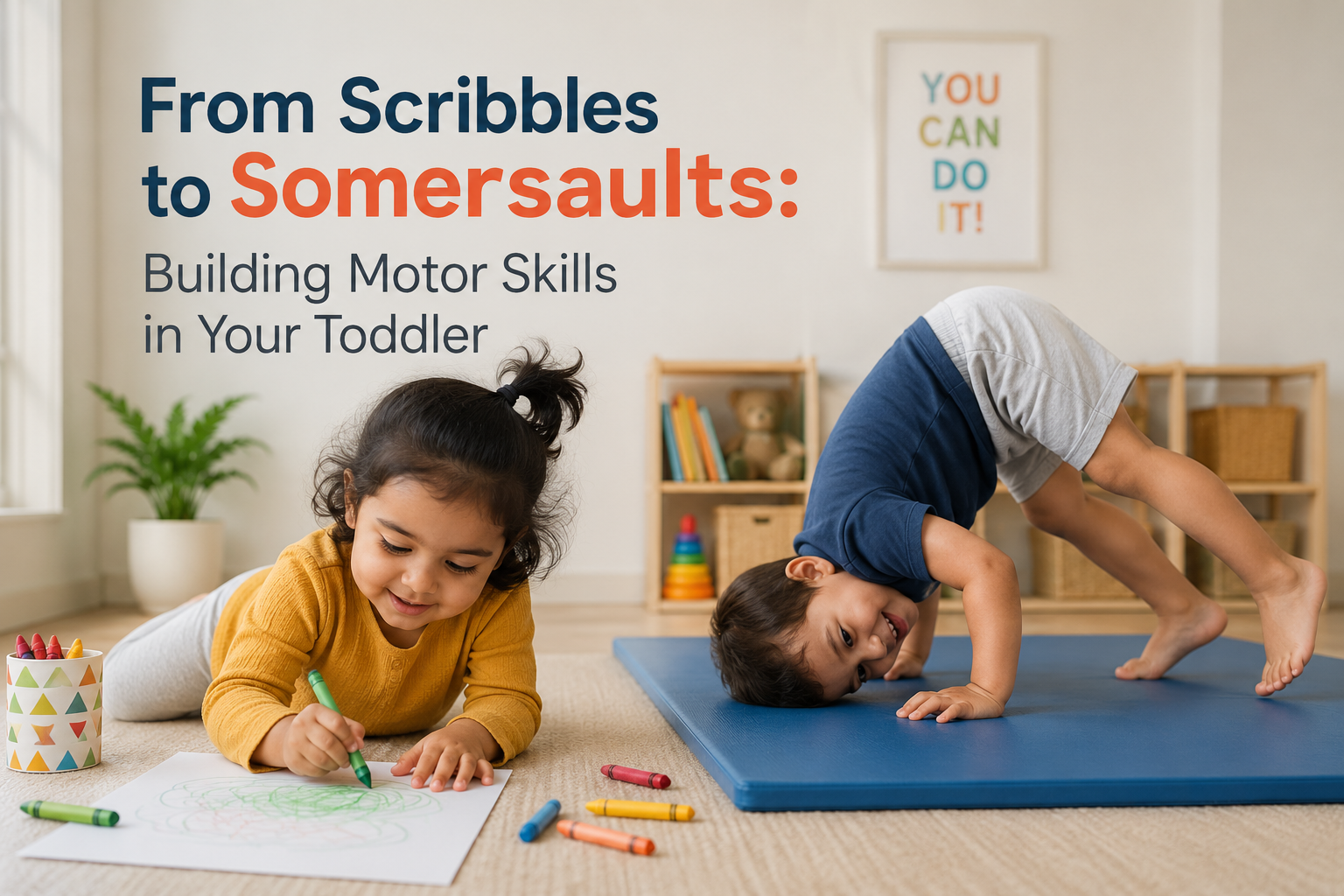

A practical guide to understanding, nurturing, and celebrating the physical milestones that shape your child’s growing body and brain.
By the Little Learners Editorial Team · 9 min read📖Related ReadingRaising Curious Kids: The Magic of Play-Based Learning→
Watch a two-year-old for just a few minutes and you will witness a marvel of engineering in motion. They squat to pick up a crumb, wobble to standing, lurch sideways to chase a ball, and then — with tremendous concentration — attempt to thread a shoelace through a hole far too small for their fingers. Every stumble, every scribble, every clumsy attempt at catching is a victory. Motor development in toddlers is not a background process. It is one of the most visible and measurable expressions of a brain growing at extraordinary speed.
Motor skills fall into two broad categories that develop in parallel and in concert. Gross motor skills involve the large muscle groups — the legs, arms, and core — and govern movements like running, jumping, climbing, and balancing. Fine motor skills involve the small muscles of the hands and fingers, and govern precision movements like grasping, pinching, drawing, and buttoning. Both are critical, and both can be nurtured through intentional, joyful play at home.

Fine motor development happens through everyday hand-on exploration
The Developmental Timeline: What to Expect and When
Every child develops at their own unique pace, and a wide variation exists within the range of “typical.” That said, developmental pediatricians use general milestone windows to track progress and identify areas that might benefit from extra support. The following table reflects commonly observed motor milestones — not hard deadlines, but useful benchmarks.
| Age Range | Gross Motor | Fine Motor |
|---|---|---|
| 12–18 months | Walking independently, beginning to run, climbing furniture | Picking up small objects with pincer grasp, stacking 2–3 blocks |
| 18–24 months | Running with more control, kicking a ball, climbing stairs with support | Scribbling with crayons, turning pages of a board book, using a spoon |
| 2–3 years | Jumping with both feet, riding a push toy, throwing overhead | Drawing basic shapes, stringing large beads, pouring from a small container |
| 3–4 years | Hopping on one foot, pedalling a tricycle, catching a large ball | Cutting with safety scissors, drawing a person, buttoning large buttons |
| 4–5 years | Skipping, balancing on one foot 10+ seconds, galloping | Writing recognizable letters, using a fork and knife, detailed drawings |
If you notice your child is consistently at the far edge of these windows, or appears to be losing skills they previously had, it is always worth raising with your paediatrician. Early referral to an occupational or physiotherapist is never a cause for alarm — it is one of the most effective gifts you can give a developing child. Earlier support consistently produces better outcomes.
Why Motor Development Matters for the Whole Child
It would be a mistake to think of motor development as purely physical — separate from the emotional, cognitive, and social development happening in parallel. In reality, all domains of development are deeply interwoven. A child who struggles with fine motor control may avoid drawing and mark-making, inadvertently limiting early literacy experiences. A toddler who lacks gross motor confidence may withdraw from group physical play, missing crucial social development opportunities.
Conversely, when motor skills flourish, children gain something profoundly important: a sense of bodily agency and confidence. The child who successfully climbs to the top of the playground structure and surveys the world from above has just received a powerful message about their own capability. That feeling — “I tried something hard and I did it” — becomes the emotional fuel for every future challenge they will face.
Movement is the child’s first language. Long before words arrive, the body speaks — reaching, grasping, running, spinning — in the vocabulary of wonder.— Dr. Sally Goddard Blythe, developmental movement researcher
There is also a direct neurological connection between movement and cognitive function. The cerebellum — the brain region most associated with motor coordination — is also heavily involved in attention, memory, and emotional regulation. When we give children rich movement experiences, we are building cognitive infrastructure. This is why many progressive early childhood educators incorporate movement breaks, yoga, and dance into academic learning, not as a reward for “real work,” but as part of the learning itself.

Gross motor play builds strength, coordination, and physical confidence
Nurturing Gross Motor Skills: Get Big and Move
Gross motor development thrives in environments that offer space, challenge, and freedom to move. The single most effective thing you can do for your toddler’s gross motor development is to give them daily, unstructured outdoor time with access to varied terrain and age-appropriate physical challenges. Hills to run down, logs to balance on, puddles to jump in, and trees to attempt to climb — these are the original gross motor gym, and they remain unsurpassed.
Indoors, the same principle applies. Push back the furniture occasionally. Let your toddler roll, crawl, and tumble across cushions on the floor. Set up a simple obstacle course using pillows, a low step stool, and a tunnel made from dining chairs draped with a blanket. The goal is not structured exercise — it is the joyful accumulation of varied movement experiences.
Music is a particularly powerful gross motor tool. When children move to rhythm — marching, spinning, clapping, stomping — they are simultaneously developing motor coordination, auditory processing, and timing. A living-room dance party is, from a developmental standpoint, remarkably productive. As explored in our companion article on play-based learning 📖 Read: The Magic of Play-Based Learning →, the richness of a child’s movement environment is one of the strongest predictors of early developmental outcomes.
Nurturing Fine Motor Skills: The Art of Small Movements
Fine motor development receives somewhat less attention than gross motor milestones, yet it is equally critical — and its implications reach far into academic life. The fine motor control required to hold a pencil, manipulate scissors, or fasten buttons is the same control that underlies early writing and reading readiness. Investing in fine motor play is an investment in school preparedness.
The good news is that fine motor activities are largely indistinguishable from play. Children do not need to know they are “working on their pincer grip” when they pick up raisins from a plate. They do not need to understand that tearing paper is developing bilateral hand coordination. The joy of the activity is enough — and that joy is what ensures sustained engagement and repetition.

Art activities build fine motor precision while nurturing creative expression
🎨
Art & Mark Making
Crayons, chunky paintbrushes, chalk, and finger painting all develop grip strength and hand-eye coordination in deeply satisfying ways.
🧱
Construction Play
Stacking blocks, DUPLO, and magnetic tiles build bilateral coordination (using both hands together) and spatial reasoning simultaneously.
✂️
Cutting & Tearing
Safety scissors are appropriate from age 2.5. Tearing paper and foil develops hand strength and the separation of finger movements.
🫙
Pouring & Transferring
Pouring water, scooping rice, and using tongs to transfer objects builds precision, grip control, and concentration in equal measure.
Playdough deserves a special mention as one of the most versatile and effective fine motor tools available. Rolling, squeezing, pinching, cutting with a plastic knife, and pressing in shapes exercises virtually every muscle group in the hand. Keep a homemade batch in the refrigerator (two cups flour, one cup salt, two tablespoons cream of tartar, two tablespoons oil, one cup boiling water) for instant, endlessly reusable fine motor play.
The Role of Creative Expression in Motor Development
Art, craft, music, and movement are not just pleasant additions to a child’s day — they are core developmental experiences that simultaneously advance motor skills, emotional intelligence, and cognitive flexibility. When a toddler draws a picture of their family — a lumpy circle with stick limbs that they identify with total confidence as “Daddy” — they are doing several remarkable things at once.
They are translating an internal mental image into a physical mark. They are exercising fine motor control. They are engaging in symbolic representation (the marks stand for people). And they are communicating something emotionally important to them. The scribble is never “just a scribble.” It is a window into a developing mind and an expression of a developing hand.
Process-focused art — where the experience of creating matters more than the finished product — is far more developmentally valuable than structured crafts where children replicate an adult model. Resist the urge to guide your child’s hand or demonstrate “the right way” to draw a tree. Instead, offer materials, step back, and let curiosity lead. Ask open questions: “Tell me about what you’re making.” “How did you make that colour?” Their answers will astonish you.
🌿 Occupational Therapist-Approved Tips for Motor Development at Home
- Provide vertical surfaces — taping paper to a wall or using an easel naturally positions the wrist for optimal fine motor control and pencil grip development.
- Encourage barefoot time indoors — walking barefoot on varied surfaces develops proprioception (body awareness) and strengthens the arches of small feet.
- Don’t rush self-care skills — allow extra time for your toddler to button their own coat, put on their shoes, and pour their own drink. These are premium fine motor opportunities hiding in plain sight.
- Incorporate “heavy work” — activities that engage the proprioceptive system, like pushing a loaded trolley, carrying a backpack, or wheelbarrow walking, are deeply regulating for the nervous system.
- Limit time in “containers” — bouncy seats, car seats, and pushchairs restrict movement. Floor time and freedom to move are irreplaceable for motor development.
- Model and narrate, but don’t intervene — show a technique once, then stand back. Struggle is productive. The motor learning happens in the attempt, not in the success.

Your engaged presence is the most powerful developmental tool of all
When to Seek Support
While developmental variation is wide and normal, there are some signs that warrant a conversation with your child’s doctor or a referral to an occupational or physiotherapist. These include: consistent avoidance of physical play, significant frustration with fine motor tasks, difficulty keeping up with same-age peers in gross motor activities, toe-walking beyond age three, or regression in previously acquired skills.
It is worth remembering that developmental support is not a verdict — it is a resource. Paediatric occupational therapists and physiotherapists are skilled at making motor development activities feel like play, and children typically thrive with their support. If your instincts tell you something is worth checking, trust them. Parents are the world’s leading experts on their own child.
Bringing It All Together: A Day of Motor-Rich Play
You do not need a specialist programme or an expensive curriculum to support your toddler’s motor development. You need intention, variety, and presence. A motor-rich day might look something like this: morning playdough and colouring at the table; a trip to the park for climbing, running, and digging in the sandpit; lunch with self-serving using a spoon and fork; quiet time with threading beads or a shape puzzle; and an afternoon of dance, obstacle courses, or water play in the garden.
Woven through each of these moments is the most important element of all: a responsive, encouraging presence. Your child does not need a coach. They need a witness — someone who notices their effort, celebrates their persistence, and communicates, in ways both spoken and unspoken, that their growing, striving, scribbling, tumbling body is magnificent.
Every wobbly step is an act of courage. Every crooked drawing is a masterpiece of effort. In the eyes of a child, the body is not a limitation — it is a universe still being discovered.
· · ·Article 1 of 3Raising Curious Kids: The Magic of Play-Based LearningDiscover how everyday play shapes your child’s brain and builds the foundations of lifelong learning.📚Up Next — Article 3 of 3The Rhythm of Childhood: Sleep, Food & Emotional WellbeingHow predictable routines, nourishing meals, and emotional coaching help your toddler truly thrive.🌙
All content is for informational purposes. Consult your paediatrician or occupational therapist for personalised guidance.