
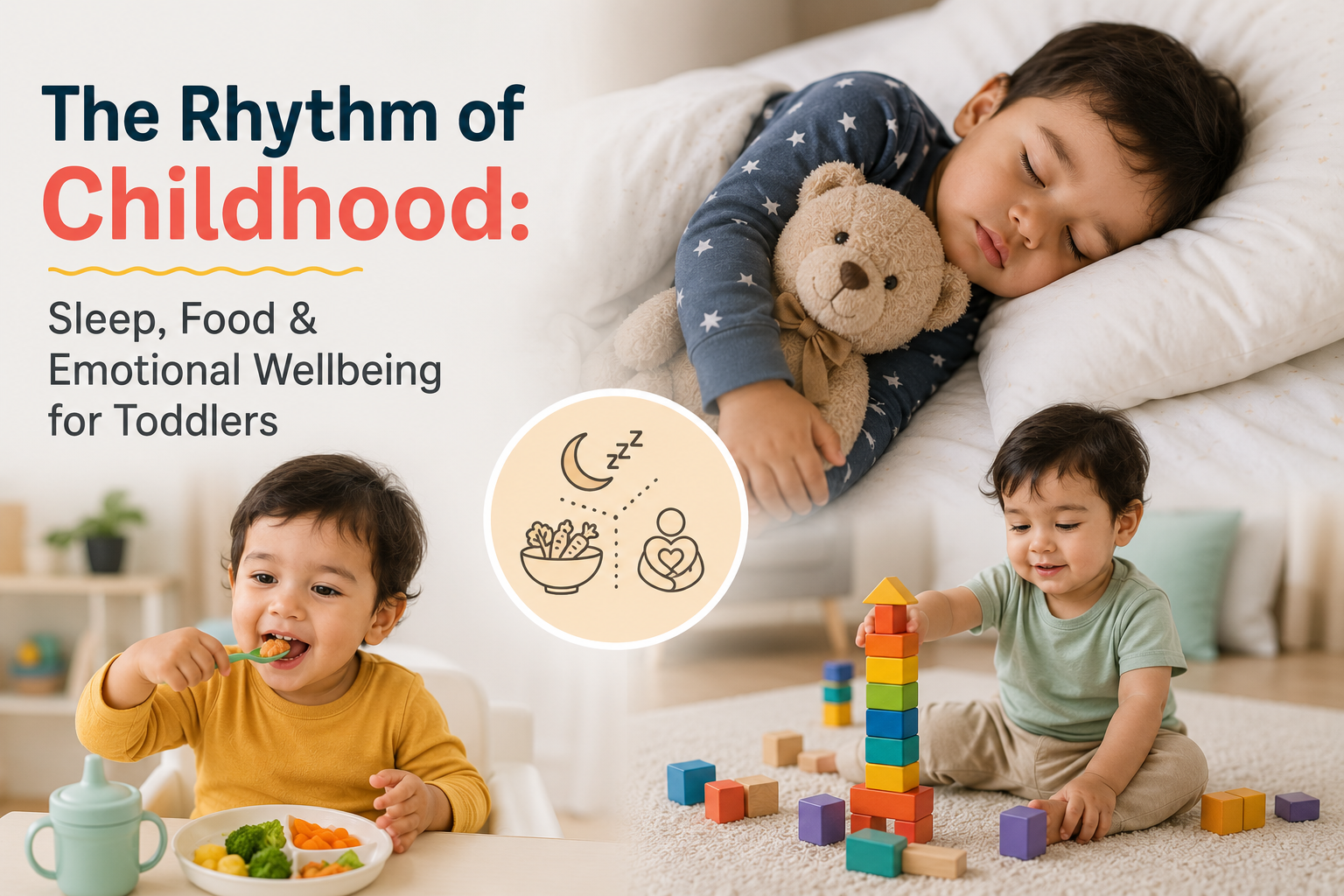

How predictable routines, nourishing meals, and emotional coaching lay the groundwork for a settled, thriving child
📚 Little Learners Series — Early Childhood
1Raising Curious Kids: The Magic of Play-Based Learning→2From Scribbles to Somersaults: Building Motor Skills in Your Toddler→3The Rhythm of Childhood: Sleep, Food & Emotional Wellbeing
There is a particular kind of exhaustion that only parents of toddlers truly know. It is the kind that lives in the bones — a cocktail of broken nights, uneaten dinners, and the emotional aftermath of a meltdown over a snapped cracker that did not, in fact, need to be in one piece. If this sounds familiar, take heart: what looks like chaos has an underlying order, and understanding it changes everything.
Young children are biological creatures of rhythm. Their bodies and brains are calibrated to cycles of activity and rest, hunger and fullness, connection and independence. When those cycles are reasonably predictable — not rigid, but consistent — children feel safe. And when children feel safe, they sleep better, eat more willingly, and regulate their emotions with far greater ease. This article explores the three pillars of that rhythm: sleep, nutrition, and emotional wellbeing.

Quality sleep is the foundation upon which all development rests
Pillar OneSleep: The Non-Negotiable Foundation
Sleep is not a passive state. During sleep — and particularly during deep slow-wave sleep and REM cycles — the toddler brain is engaged in some of its most critical work: consolidating memories from the day, pruning unnecessary neural connections, regulating stress hormones, and releasing growth hormone. A child who is consistently undersleeping is a child whose brain is consistently underperforming.
The research is unambiguous: sleep-deprived toddlers show measurably poorer attention, impulse control, emotional regulation, and immune function. Interestingly, the sleep-deprivation paradox is real in young children — an overtired toddler often appears hyperactive rather than drowsy, as the brain floods the system with cortisol and adrenaline to compensate for fatigue. The child who cannot settle at bedtime is frequently the child who needed to be in bed an hour earlier.
1–2 years
11–14
hours total
(inc. 1–2 naps)
2–3 years
11–14
hours total
(1 nap common)
3–5 years
10–13
hours total
(naps fading)
5–7 years
9–11
hours total
(nights only)
Building a Bedtime Routine That Actually Works
A consistent bedtime routine is one of the most evidence-backed parenting strategies available. Studies show children with regular, predictable bedtime sequences fall asleep faster, wake less overnight, and wake in a better mood. The routine works because it signals the nervous system to begin its transition from active wakefulness to sleep readiness — a process that takes roughly 20–30 minutes in young children.
The content of the routine matters less than its consistency. Bath, pyjamas, a story, a song, lights out — or any version thereof — works when it is repeated nightly in roughly the same order at roughly the same time. Predictability is the point. The toddler brain, still developing the capacity to regulate its own arousal, uses external cues to know what state it should be moving toward.
6:30 PM
Wind-Down Begins
Reduce screens and stimulating play. Move to quieter, lower-light activities. Dim overhead lights where possible.
6:45 PM
Bath & Pyjamas
Warm water lowers core body temperature post-bath, which naturally triggers sleepiness. Keep it calm and unhurried.
7:10 PM
Story & Connection
One to two books read in a calm voice. This is also a natural moment for brief emotional check-ins — “What was your favourite part of today?”
7:25 PM
Transition Ritual
A consistent closing sequence — the same song, three deep breaths, or a simple phrase like “sleep tight, I love you” — marks the boundary of the routine reliably.
7:30 PM
Lights Out
Consistent timing, even on weekends, stabilises the circadian rhythm and makes the whole routine easier over time.

Mealtimes are about nourishment, exploration and connection — not perfection
Pillar TwoNutrition: Feeding a Growing Brain
No topic in toddler parenting generates more anxiety than food. The child who ate everything at twelve months and now survives on white carbohydrates and mild panic is almost a rite of passage. Neophobia — the fear of new foods — peaks between ages two and six and is a developmentally normal, evolutionarily sensible behaviour: at the age when toddlers began to move independently in ancestral environments, caution around unfamiliar foods was protective.
Understanding this does not make the mealtime battles less exhausting, but it does reframe them. The child refusing broccoli is not being difficult — they are being a toddler. The most effective approach, consistently supported by research in paediatric dietetics, is Ellyn Satter’s Division of Responsibility: parents decide what food is offered, when, and where; children decide whether to eat and how much. This division, when maintained consistently, reduces mealtime conflict and — over months, not days — produces more adventurous eaters.
🥦
Vegetables & Fruit
- Offer at every meal without pressure
- Pair with familiar, accepted foods
- Roasting often increases acceptance
- Repeated neutral exposure is key
🍳
Protein & Iron
- Eggs, beans, lentils, meat, tofu
- Iron is critical for brain development
- Pair with vitamin C to boost absorption
- Finger foods increase engagement
🧀
Fats & Dairy
- Full-fat dairy for toddlers under 2
- Avocado, nut butters, oily fish
- Omega-3s support brain myelination
- Do not restrict healthy fats
Practical strategies that research supports include: eating together as a family as often as possible (children are powerful mimics and will eventually eat what they see adults enjoying); offering new foods alongside accepted “safe” foods rather than as the sole option; avoiding pressuring, bribing, or rewarding eating with dessert; and trusting that a child who is growing along their own curve and has normal energy levels is eating enough, even when it does not look like it from the parent’s side of the table.
A toddler’s appetite is not a problem to be solved. It is a conversation to be respected — one the body is already having with itself, in a language older than words.— Ellyn Satter, feeding therapist and researcher
One frequently overlooked aspect of toddler nutrition is hydration. Young children have a higher body water percentage than adults but a less reliable thirst signal. Offering water consistently throughout the day — particularly before, during, and after physical activity — supports concentration, mood regulation, and digestive health. Limit fruit juice, which delivers sugar without the fibre of whole fruit, and avoid sugary drinks entirely before age five.

Co-regulation — your calm presence — teaches children how to manage big feelings
Pillar ThreeEmotional Wellbeing: Raising Emotionally Intelligent Children
The toddler years are the age of the big feeling. Joy, rage, terror, delight — toddlers feel everything at full volume, with minimal filter and almost no ability to self-regulate. This is not a character flaw. The prefrontal cortex — the region of the brain responsible for impulse control, emotional regulation, and rational decision-making — is not fully developed until the mid-twenties. Asking a two-year-old to “calm down” is physiologically equivalent to asking them to regrow their frontal lobe on demand.
What toddlers can do, with consistent support, is learn the foundations of emotional intelligence: recognising and naming their own feelings, understanding that feelings are temporary, developing early coping strategies, and experiencing the profound reassurance of a caregiver who remains calm in the face of their storms. This process — called co-regulation — is the precursor to self-regulation, and it cannot be rushed or bypassed.
As we explored in our first article in this series on play-based learning, emotional development is inseparable from all other domains of growth. Children who feel emotionally secure explore more boldly, engage more deeply with learning, and build stronger social relationships. Emotional safety is not a soft extra — it is the ground everything else grows from.
✦ The Five Steps of Emotion Coaching
- Notice and name the feeling — “You look really frustrated. The block tower fell down and that was upsetting.”
- Validate without fixing — “It makes sense you’re upset. You worked so hard on that.” Resist the urge to immediately problem-solve or minimise.
- Stay regulated yourself — Your nervous system co-regulates your child’s. A calm, low voice and relaxed body communicate safety more effectively than any words.
- Set limits on behaviour, not feelings — “It’s okay to feel angry. It’s not okay to hit. Let’s find another way.”
- Problem-solve together, once calm — After the storm passes, briefly revisit what happened and brainstorm alternatives. This builds emotional vocabulary and coping skills over time.
Tantrums — the most visible expression of toddler emotional dysregulation — deserve particular attention because they are so universally dreaded and so deeply misunderstood. A tantrum is not manipulation. It is a nervous system in genuine overwhelm, past the point where language and reasoning are accessible. The most effective response is not discipline — it is presence. Staying nearby, speaking softly, and waiting for the storm to pass without withdrawing love or connection teaches children that big feelings are survivable and that they will not be abandoned in them.

A child who feels safe, fed, and rested is free to be fully, joyfully themselves
Bringing It TogetherThe Whole-Child Approach to Daily Rhythm
Sleep, nutrition, and emotional wellbeing are not separate concerns to be tackled independently. They form an interconnected system in which each element profoundly affects the others. A child who is undersleeping will be more emotionally volatile and have a dysregulated appetite. A child who is eating poorly will have less energy for physical play and poorer emotional resilience. A child who is emotionally dysregulated will often struggle to settle to sleep. The system is circular, which means that improvements in any one area tend to ripple positively through the others.
This is why the whole-child lens matters so much in early childhood. Addressing bedtime battles without acknowledging daytime emotional overwhelm often fails. Worrying about nutrition without examining the emotional climate of mealtimes misses half the picture. From the physical milestones we covered in our motor skills guide to the play environments explored in our first article, every dimension of a child’s world feeds into this daily rhythm. The child in front of you is a whole person in a whole context, and they thrive when that context is calm, consistent, and full of connection.
You will not get any of this right every day. The routine will collapse on holidays. The toddler will refuse every food group simultaneously for a week. The tantrum will happen in the supermarket, spectacularly. None of this undoes the work you are doing. Children are not built in single perfect days — they are built in thousands of ordinary ones, shaped by the warmth, consistency, and love woven through the mundane fabric of daily life.
It is not in the grand gestures but in the ten thousand small moments of presence — the patient wait at bedtime, the shared plate, the arms open at the end of a hard feeling — that a childhood is made.
✦ ✧ ✦
Raising Curious Kids: The Magic of Play-Based Learning→🌱Article 2 in SeriesFrom Scribbles to Somersaults: Building Motor Skills→
All content is for informational purposes. Always consult your paediatrician or a registered dietitian for personalised guidance.